
Project Overview
Background
A well-established and highly regarded manufacturer in the food industry operates multiple production sites in Southern California, producing several hundred SKUs across facilities totaling more than 55,000 square feet. Known for its strong product portfolio and long-standing presence in the market, the organization has built a reputation for quality and reliability over decades of operation.
As the business continued to grow and expand its footprint, leadership recognized that existing operational practices were beginning to limit scalability, consistency, and overall performance. While demand remained strong, internal systems and execution rhythms had not kept pace with the complexity of the operation.
To support the next phase of growth, the organization partnered with POWERS to strengthen execution discipline, develop internal continuous improvement capabilities, and implement operational systems designed to deliver sustainable, long-term results.
Situation
The engagement was structured as a 26-week initiative with an aggressive mandate: deliver meaningful operational improvement quickly while building internal capability and ownership.
Leadership aimed to increase throughput and labor productivity by rebalancing lines, reducing bottlenecks, and improving labor allocation. Plant layouts and material flow needed to be redesigned to reduce congestion, waste, and non-value-added motion. Slow shift startups, inconsistent shift handoffs, and limited visibility into daily performance were eroding results and accountability.

Performance Results
Read the Full Case Study Here
At the same time, the organization wanted to move forward with automation and capital investments but lacked a consistent way to evaluate financial returns, operational risk, and capacity impact. Strengthening supply chain coordination, demand-driven scheduling, and KPI visibility was essential to improving responsiveness and leadership effectiveness. Developing supervisors and frontline leaders was seen as critical to sustaining any gains.
Analysis
Early diagnostics conducted by the POWERS team revealed that the most significant barriers to performance were systemic rather than equipment-driven.
Supervisors and leads had limited exposure to lean concepts and little formal leadership training. Shifts often started without clear priorities or direction, and daily meetings lacked structure and follow-through. Slow shift startups were a recurring source of lost production, yet downtime was not consistently tracked or analyzed, making root causes difficult to identify.
Communication between shifts was weak, with limited accountability for performance carryover. Action plans were informal and inconsistently followed. Department-level KPIs were either undefined or not actively used, leaving leadership without reliable visibility into trends or risks.
Material shortages frequently disrupted production and were often discovered too late due to manual, spreadsheet-driven planning processes. Maintenance work orders were paper-based and inconsistently closed, limiting insight into chronic issues. Safety incidents were occurring at an elevated rate, with little proactive identification of latent risks.
Collectively, these issues pointed to the absence of a consistent Management Operating System and a lack of real-time operational visibility.
Plan
The POWERS team partnered closely with plant leadership to implement a structured improvement plan centered on execution, accountability, and capability building. A core element of this effort was the deployment of DPS, our Digital Production System, as the operational backbone for daily management.
Key elements of the plan included:
- Establishing consistent downtime measurement, recording, and analysis
- Deploying DPS to diagnose operational efficiency and identify productivity opportunities
- Introducing shift-start assessments to improve startup effectiveness
- Implementing structured Action Lists to drive ownership, due dates, and follow-through
- Rolling out a tiered meeting structure as the heartbeat of the Management Operating System
- Standardizing shift huddles, handoffs, daily direction setting, and weekly reviews
- Defining and coaching supervisor standard work
- Implementing risk reporting and behavior observation tied to regular Gemba walks
To strengthen planning, data integrity, and decision-making, the team also:
- Improved ERP posting interfaces to increase compliance and accuracy
- Implemented digital maintenance work order management
- Introduced capacity modeling to validate schedules and growth plans
- Strengthened material planning using existing ERP and MRP tools
- Applied structured change management and financial business case methods to evaluate automation and capital investments
DPS Impact on Performance
The POWERS team embedded DPS into the organization’s Management Operating System to create real-time visibility into performance, losses, and capacity utilization. Even in the early stages, DPS-enabled cycle time studies exposed major imbalances in the highest-running SKU. Using objective data, operations leadership reduced packing line headcount by 35 percent (from 17 to 11 people per shift) while establishing a more demanding rate standard, immediately improving execution discipline and labor efficiency.
As DPS data matured, the team uncovered recurring micro-stops that had previously gone unnoticed. Replenishment delays of up to two minutes, occurring 26 times per shift, were collectively costing nearly one hour of production per shift. Addressing these issues through operator standard work and layout adjustments led to rapid gains.
Within one month, the soup packing line achieved a 33 percent increase in cases per shift, setting a new throughput record. DPS also identified chronic downtime from clogged glue nozzles and label change interruptions, which were corrected through targeted retraining, maintenance upgrades, and upstream coordination, enabling record output of 1,300 cases per shift and eliminating losses equivalent to three pallets per shift.
At the value-stream level, DPS trend analysis revealed that frozen packing operations were running at roughly 50 percent capacity utilization due to misaligned work-in-process strategies. With this visibility, management adjusted upstream production and flow, significantly improving synchronization across operations. As a result, capacity utilization increased dramatically, with recent performance reaching as high as 97 percent, reinforcing DPS as a key driver of sustained productivity and labor cost reduction.
Results
The engagement delivered measurable improvements across productivity, safety, and financial performance:
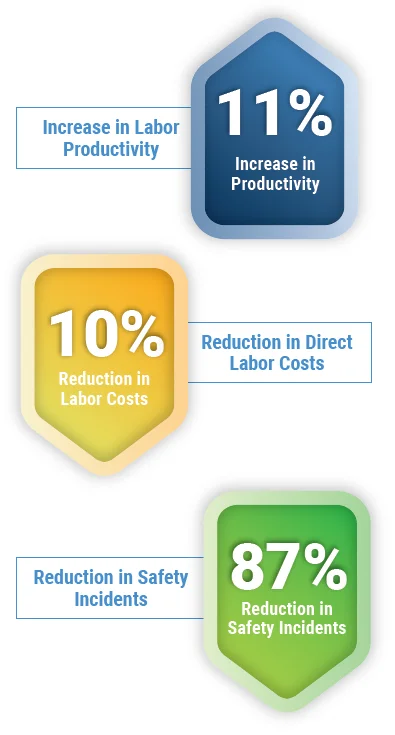
- 11% increase in labor productivity, with pounds per labor hour reaching 50 versus a previous high of 45
- 10% reduction in direct labor costs, driven by improved line balance, higher utilization, and reduced unplanned downtime
- Record output levels achieved across multiple packing operations
- Approximately $750,000 per year in identified savings potential, enabled by improved capacity utilization and DPS-driven downtime analysis
- ERP posting compliance increased to 90–95%, significantly improving data reliability
- Safety performance improved, with recordable incidents reduced from an average of four per month to approximately 0.5
- Multiple capital investments approved, supported by validated business cases and projected ROI under three years
Behavioral Shifts
Beyond the metrics, the organization experienced meaningful changes in how work was managed. Communication and alignment improved across departments and shifts. Accountability increased as standards, documentation, and follow-up became part of daily routines rather than exceptions.
Supervisors and employees reported greater clarity, support, and engagement. Most importantly, improvement efforts were viewed as sustainable, supported by leadership commitment and a management system designed for long-term ownership.