

Project Overview
Background
In high-volume protein manufacturing, yield rarely collapses overnight. It erodes quietly. A few tenths of a point in give-away. Slightly higher trim. Inconsistent execution between crews. Each issue looks manageable in isolation, but together they compound into real margin loss.
That was the challenge facing a premium protein manufacturer entering a critical production period. Demand was strong. Volumes were rising. But yield performance was under pressure, and leadership needed confidence that results would hold, not just on the best days, but across every shift.
POWERS was engaged to stabilize yield performance, reduce give-away, and strengthen the Management Operating System required to sustain results under peak demand.
The Challenge Wasn’t Effort. It Was Repeatable Control.
The plant team understood the drivers of yield loss in principle. What was missing was consistent, real-time control. Data accuracy and accountability were not strong enough to create clear ownership. Maintenance and sanitation activities were not always aligned to the yield loss drivers that mattered most. In that environment, variation had room to grow.
Leadership needed tighter visibility into yield performance, faster escalation when losses appeared, and supervisor routines that could be executed consistently under real production pressure.
The objective was not to chase one-time gains. It was to put a system in place that could hold yield steady as volume, complexity, and pace increased.

Performance Results
Read the Full Case Study Here
Objective And Scope
The Yield Improvement Project was a focused engagement aligned to peak production demand. The objectives were clear:
- Reduce yield loss by tightening execution and reducing give-away
- Improve real-time visibility into yield loss drivers
- Strengthen data accuracy and accountability across key KPIs
- Align maintenance and sanitation activities to yield loss drivers
- Embed MOS behaviors at the supervisor level so gains could be sustained
The engagement was structured as a concentrated 13-week effort designed to deliver measurable results quickly while building durable operating discipline.
Turning Yield into a Daily Discipline
POWERS approached the engagement as an execution and control challenge, not a technical one-off. The focus was on how the operation ran every day and how leaders followed up when performance drifted.
Daily yield visibility and short-interval follow-up routines were reinforced so deviations surfaced early and could be addressed before losses compounded. Supervisors were coached directly on the floor to lead with MOS behaviors, reinforce expectations consistently, and close the loop on issues rather than simply reporting them.
Maintenance and sanitation activities were aligned more tightly to the yield loss drivers, reducing recurring sources of variation. At the same time, data accuracy and accountability were strengthened so performance discussions were grounded in reliable information, not assumptions.
The result was a tighter operating rhythm, clearer ownership, and less space for yield loss to hide.
Results
Yield And Financial Performance
During the engagement, the operation delivered measurable yield improvement under peak demand conditions.
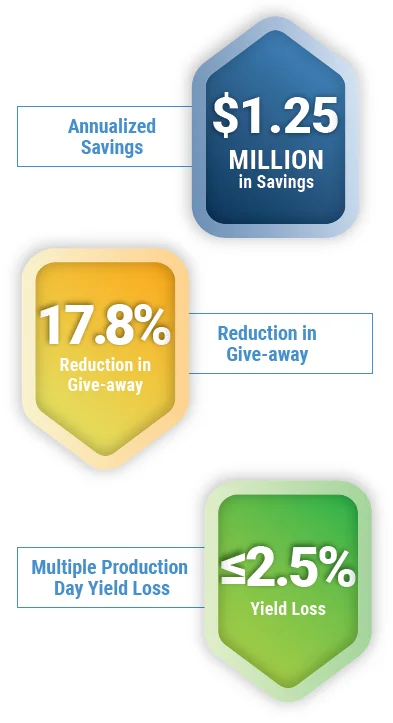
Give-away was reduced from 0.45% to 0.37%, representing a 17.8% improvement. The plant confirmed this reduction as yield loss improvement, not a measurement artifact or portioning adjustment.
Multiple production days achieved yield loss at or below 2.5%. Based on these sustained results, the Vice President of Production validated a conservative annualized savings estimate of $1.25 million.
Measurable Improvements in Yield Loss Drivers
As data accuracy and accountability improved, the operation delivered reportable reductions across multiple yield loss and inedible categories. Each metric was tracked independently against baseline performance:
- Bloodloss improved by approximately 66.7%
- Grind inedibles improved by approximately 16.9%
- Production inedibles improved by approximately 6.19%
- Sanitation losses declined by approximately 50%
- Give-away improved by approximately 17.8%
These improvements were not rolled up into a single metric. Each reflects tighter execution control, clearer ownership, and faster response to deviations on the production floor.
Execution And Operating System Improvements
Beyond the headline yield results, the engagement strengthened the operating discipline required to sustain performance:
- Data accuracy and accountability improved, enabling clearer visibility into yield loss drivers
- Maintenance and sanitation activities were aligned to the drivers with the greatest yield impact
- Supervisors consistently embedded MOS behaviors and follow-up routines
Maintenance cost reductions were not quantified before the project concluded. At the time of transition, new plant leadership was in the process of estimating those impacts.
Results at a Glance
Financial Impact
- $1.25M in annualized savings, validated by the Vice President of Production
Yield And Loss Reduction
- Give-away reduced 17.8%, from 0.45% to 0.37%, confirmed as yield loss improvement
- Multiple production days achieved ≤2.5% yield loss
Supporting KPI Improvements
- Bloodloss improved ~66.7%
- Grind inedibles improved ~16.9%
- Production inedibles improved ~6.19%
- Sanitation losses declined ~50%
The Takeaway
Sustained yield improvement does not come from isolated fixes. It comes from leaders and supervisors running the same disciplined system, every shift, with clear visibility and consistent follow-up.
By tightening control of yield loss drivers, improving data accountability, and embedding MOS behaviors at the supervisor level, POWERS helped this manufacturer deliver defensible financial impact while building a stronger foundation for sustained performance through peak season volatility.