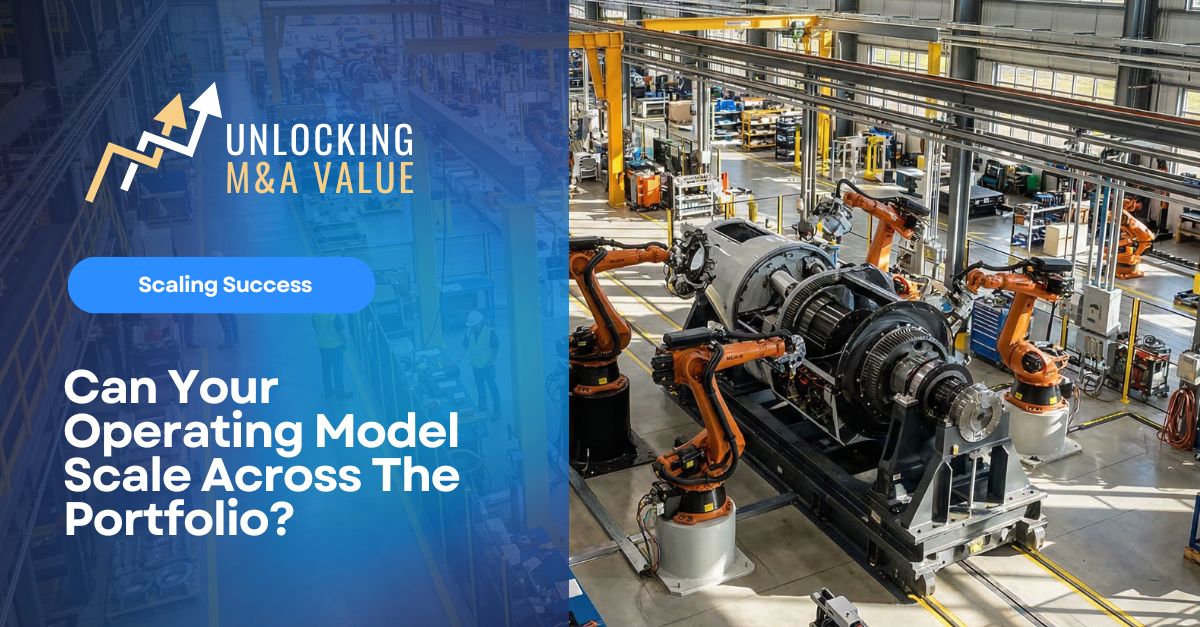
Private equity firms expand platform companies through roll-up strategies, acquiring multiple businesses within the same segment and combining them into a larger operating enterprise. Strategic buyers acquire complementary companies to expand capabilities, enter new markets, or strengthen supply chain resilience.
In many cases, the strategic rationale is sound. Markets align. Product portfolios complement one another. Financial projections support the investment.
Yet once the transaction closes and integration begins, leadership teams often encounter a question that was never fully addressed during the deal process:
Can the operating model that created success in one organization scale across the portfolio?
Acquisition Expands Complexity Faster Than The Operating Model
Growth through acquisition adds more than revenue, facilities, and employees. It expands the operational system expected to support the enterprise.
These differences rarely surface during diligence. Financial performance and asset condition are easier to evaluate than the daily management routines and leadership behaviors that actually drive operational results.
But once organizations begin operating as a single enterprise, those differences quickly become visible.
What once functioned effectively within separate organizations may now produce uneven performance across the combined portfolio.
Integration Plans Focus On Structure, Not Operations
Most acquisition integration plans focus on predictable priorities.
Financial reporting must be consolidated. IT systems must be aligned. Organizational structures must be defined. Procurement and supply chain strategies must be reviewed.
These are necessary steps, but they address structural alignment rather than the way work is executed every day.
Questions about production standards, escalation discipline, daily management routines, and frontline leadership expectations often receive far less attention. Yet these are the mechanisms that determine whether operational performance remains consistent as the enterprise expands.
Portfolio Growth Requires Operating Consistency
As portfolios expand through acquisition, leadership teams often discover that performance varies widely across locations.
One facility may operate with strong escalation routines and consistent production standards, while another follows entirely different practices. One leadership team may enforce structured daily management routines, while another relies more heavily on individual problem-solving.
Over time, these differences create measurable operational variability across the enterprise.
The result is not a single scalable operating model, but a network of different management approaches operating under the same corporate umbrella.
For organizations pursuing growth through acquisition, this variability becomes increasingly difficult to manage.
Scaling Through Acquisition Requires Operational Portability
Successful acquirers recognize that scaling through acquisition requires more than integrating companies. It requires expanding the operating architecture that governs how work is executed across the enterprise.
Operational systems must translate across organizations. Leadership expectations must remain consistent across sites. Performance metrics must provide visibility that allows leadership teams to evaluate operations using common definitions.
When these elements move together, performance becomes portable. Improvements achieved in one organization can transfer across the broader enterprise.
When they do not, each acquisition introduces additional variability, making sustained performance harder to maintain.
The Question Leaders Should Ask Before The Next Deal
Growth through acquisition will remain a central strategy for many manufacturers, particularly in industries where consolidation continues to reshape competitive landscapes.
But before the next transaction moves forward, leaders should ask a more operational question.
Can the operating model that created success in one organization scale across the portfolio?
Because the true measure of value creation in M&A is not simply how many companies an organization acquires.
It is whether performance holds as the enterprise grows.
About POWERS
POWERS helps manufacturers move from underperformance to stability, from stability to sustained high performance, and from high performance to scalable operational excellence.
When manufacturers grow through acquisition, sustaining performance across the portfolio becomes increasingly complex. New leadership teams, operating routines, and production environments must ultimately function under a shared operating model if results are expected to hold across the enterprise.
Through frontline leadership development, stronger operational systems and processes, and a Management Operating System that reinforces accountability, POWERS helps organizations align operating expectations across facilities and companies within the portfolio.
DPS, our proprietary digital production system, reinforces this work by providing real-time operational visibility that connects executives, plant leadership, and frontline teams to the same performance signals and priorities.
For organizations scaling through acquisition, POWERS helps ensure the systems, leadership behaviors, and operational discipline required to sustain performance travel with the enterprise as it grows.
- Speak to an Expert: Call +1 678-971-4711
- Email Us: info@thepowerscompany.com
- Request an Assessment: Visit our online contact form to schedule an assessment with our expert consultants.