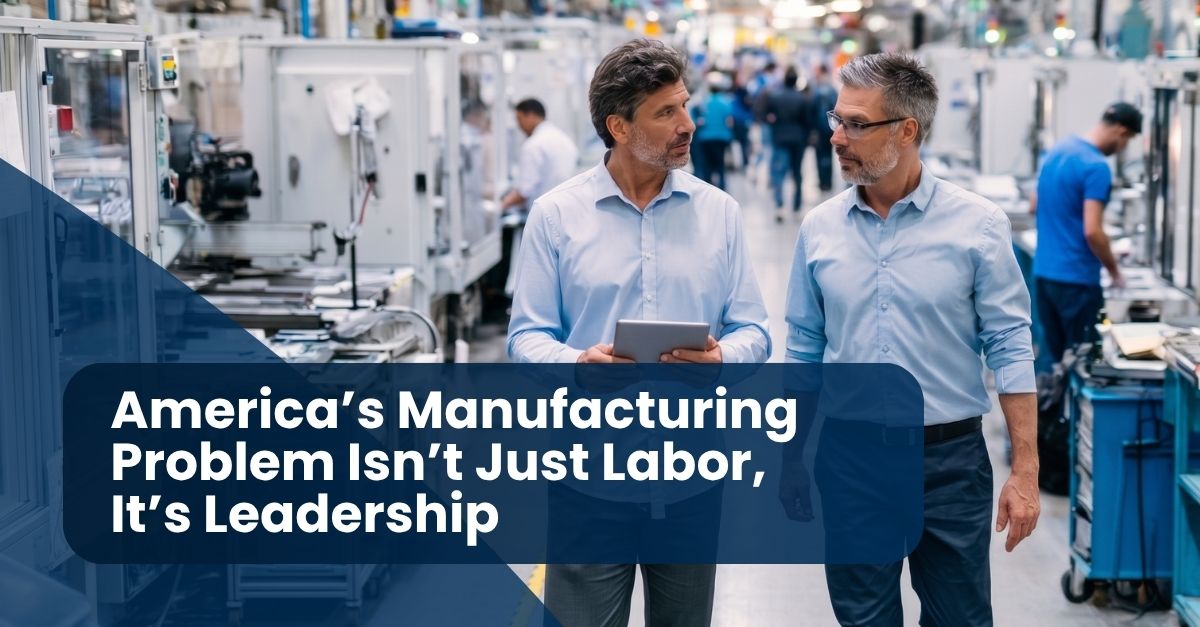
For the past several years, the conversation around American manufacturing has centered on labor: skilled labor shortages, workforce availability, retirements, recruiting challenges, and wage pressure.
Those issues are real. But across manufacturing, mining, energy, and industrial operations, another problem is becoming increasingly difficult to ignore.
America does not just have a workforce gap. It has a frontline leadership gap, and that gap may ultimately determine whether reindustrialization succeeds.
The pattern is beginning to show up across nearly every industrial sector. In mining, one of the industries critical to semiconductors, electrification, defense systems, and energy infrastructure, executives are openly warning about the leadership pipeline developing behind the retirement wave now underway. More than half of the U.S. mining workforce is expected to retire by 2029, while companies are struggling to replace not only technical labor, but experienced operational leaders capable of running complex operations, developing teams, reinforcing accountability, and sustaining execution discipline under pressure.
The same problem is emerging across manufacturing. Companies promoted strong operators and technicians into leadership roles for years without ever truly teaching them how to lead.
The result is visible inside operations across the country. Reactive firefighting becomes normalized, accountability weakens, execution becomes inconsistent, supervisors burn out, and operational instability increases.
At the same time, billions of dollars are flowing into new factories, reshoring initiatives, industrial expansion projects, energy infrastructure, and domestic supply chain investment.
The buildings are going up, but the question is whether operations will have the leadership capability required to run them.
Reindustrialization Creates Pressure Faster Than Leadership Pipelines Can Respond
America is entering a period of industrial expansion many sectors have not experienced in decades. New plants are being built, production is being reshored, and AI and automation are increasing operational complexity while demand for reliability and throughput continues rising.
Leadership development pipelines inside many industrial organizations were never designed for this pace of growth.
For decades, many manufacturers operated in relatively stable environments with slower expansion cycles, lean staffing structures, and limited investment in structured frontline leadership development. Today, those same organizations are being asked to scale rapidly while replacing retiring leaders, onboarding inexperienced supervisors, integrating new technology, and maintaining performance under increasing pressure.
That creates a dangerous operational gap because the return on these industrial investments will not ultimately be determined by the size of the facility, the sophistication of the automation, or the amount of capital deployed.
It will be determined by whether the operation can consistently deliver throughput, yield, uptime, safety, quality, and labor productivity every shift, every day.
The Frontline Leader Determines Whether Systems Actually Work
Most manufacturing organizations already understand what good operations should look like. They understand the importance of standardization, accountability, operational discipline, maintenance coordination, safety systems, production planning, and continuous improvement.
The challenge is rarely awareness. The challenge is whether those expectations are consistently reinforced on the floor.
That responsibility falls primarily on frontline leadership. Supervisors and frontline managers determine whether standards hold or drift, whether accountability becomes real or performative, and how teams respond to pressure, downtime, staffing shortages, changing schedules, and operational abnormalities. Ultimately, they determine whether the operation becomes proactive or reactive.
Strong frontline leaders create operating rhythm. They reinforce standards consistently, coach operators in real time, escalate issues early, follow through on commitments, and build stability into the operation.
Weak frontline leadership creates variability. Problems linger longer, communication breaks down, accountability becomes inconsistent, teams lose confidence in the system, and improvement initiatives stall because no one is sustaining the behaviors required to support them.
Technology cannot solve those problems by itself. AI can improve visibility, identify patterns faster, accelerate reporting, and improve responsiveness. But AI cannot coach accountability during a difficult shift, reinforce discipline after a production disruption, build trust across a team, or develop future leaders. That still happens person to person, shift by shift, every day.
Leadership Development Is Becoming a Competitive Advantage
The manufacturers beginning to separate themselves are recognizing this earlier than others.
They are no longer treating frontline leadership development as a secondary HR initiative or optional training exercise. They are treating it as operational infrastructure.
The strongest organizations are investing in structured supervisor development, Management Operating Systems, coaching systems, accountability routines, operational leadership training, and AI-enabled decision support because they understand operational performance depends on leadership capability at the floor level.
Factories do not run themselves. People do.
And the quality of leadership inside an operation directly affects how quickly organizations stabilize performance, ramp production, reduce turnover, improve reliability, sustain safety standards, and convert investment into measurable returns.
This becomes especially important during periods of expansion.
A new site ramp-up, major capacity increase, or reshoring initiative places enormous pressure on operations. The pace accelerates, expectations rise, and leadership capability gaps that once remained hidden quickly become impossible to ignore.
Organizations that already have strong frontline leadership systems in place tend to stabilize faster, while organizations that do not often spend years trying to recover consistency.
The Next Industrial Advantage Will Be Built on Leadership Capability
For years, operational conversations focused heavily on labor availability. The next decade will increasingly focus on leadership capability because the issue is no longer simply whether organizations can hire enough people. It is whether they can build enough capable leaders to manage increasingly complex operations under real-world pressure.
That challenge will shape manufacturing performance across the United States far more than many companies currently realize.
The manufacturers that lead during America’s next industrial cycle will not simply be the ones with the newest technology, largest capital investments, or most advanced automation. They will be the organizations capable of building disciplined leadership systems that translate strategy into stable operational execution.
That means supervisors capable of leading teams through pressure and change, management systems capable of reinforcing accountability daily, and operational cultures capable of sustaining discipline even when conditions become difficult.
Where POWERS Fits
At POWERS, we work directly with manufacturers to strengthen frontline leadership capability, improve operational discipline, and install the Management Operating Systems required to support consistent execution across shifts, sites, and expanding operations.
Our work focuses on helping organizations close the gap between executive expectations and shop-floor performance through leadership development, accountability systems, operational routines, coaching structures, and execution discipline that sustain measurable results over time.
As reindustrialization accelerates across the United States, manufacturers are increasingly discovering that operational performance depends as much on leadership capability as technology, equipment, or capital investment.
The factories are being built. The real question is who is prepared to lead them.
About POWERS
POWERS helps manufacturers strengthen operational execution through frontline leadership development, Management Operating Systems, and operational discipline that improve consistency across shifts, sites, and expanding operations.
DPS, our Digital Production System, provides real-time operational visibility that helps leadership teams reinforce accountability, improve responsiveness, and support more disciplined execution across the floor.
Speak to one of our expert consultants to schedule an assessment.
- Speak to an Expert: Call +1 678-971-4711
- Email Us: info@thepowerscompany.com
- Request an Assessment: Visit our online contact form to schedule an assessment with our expert consultants.