For decades, discussions about manufacturing often focused on decline. Production moved offshore. Facilities closed. Supply chains stretched across continents. Entire industries became increasingly dependent on foreign manufacturing capacity. Concerns about competitiveness, resiliency, and industrial capability became recurring themes in both business and policy discussions.
Today, the conversation sounds very different.
New manufacturing facilities are being announced across the country. Existing operations are expanding. Billions of dollars are being invested in semiconductors, automotive production, energy infrastructure, advanced manufacturing, and reshoring initiatives. Manufacturing investment has once again become a national priority.
This is unquestionably positive news for American industry.
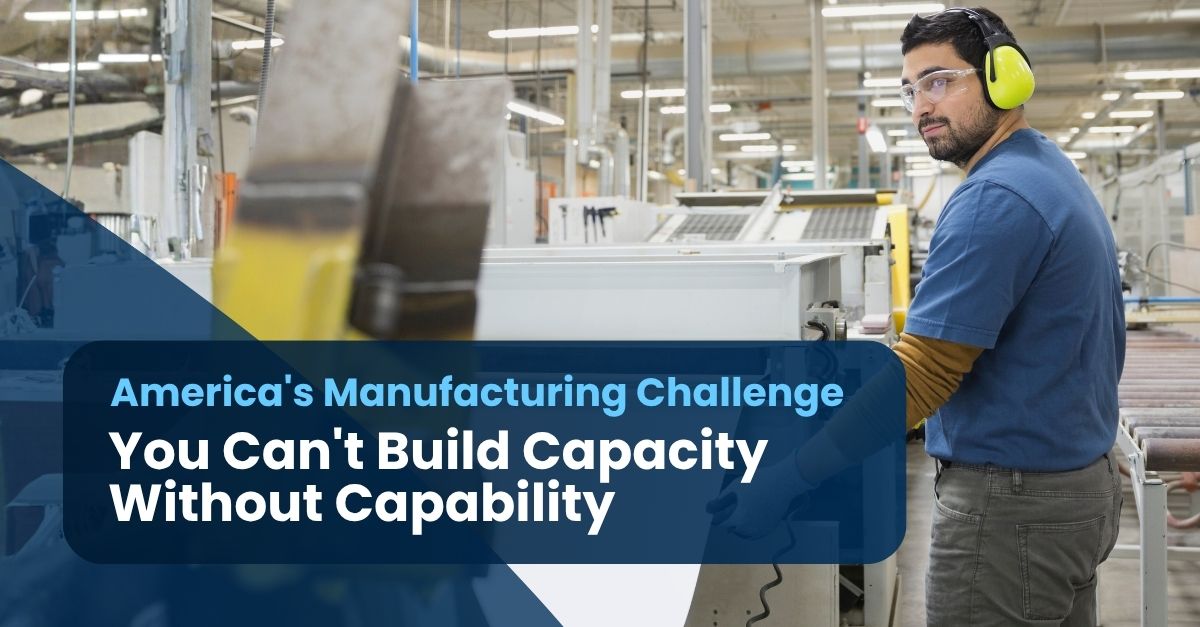
Capacity and capability are not the same thing.
The United States is investing heavily in manufacturing capacity, and that capacity could not be created without significant manufacturing capability. The larger question is whether organizations are continuing to develop the capabilities required to sustain growth as operations become larger and more complex.
That distinction may ultimately determine whether the current wave of reindustrialization achieves its full potential.
Building factories is not the same as building performance
When a new manufacturing facility is announced, the conversation often focuses on investment dollars, square footage, equipment, production volume, and job creation. These are tangible metrics that are easy to measure and easy to communicate.
What receives far less attention is the work required after the facility opens.
A new building creates potential. New equipment creates potential. Additional capacity creates potential.
None of those things automatically create performance.
Performance is ultimately determined by an organization’s ability to consistently execute. It is reflected in how effectively a facility operates, how reliably production targets are achieved, how quickly problems are solved, how well standards are maintained, and how consistently results can be reproduced over time.
Manufacturing history is filled with examples of facilities that opened with tremendous promise and significant investment but struggled to achieve projected performance levels. The issue was rarely the building itself. It was rarely the equipment. In most cases, the challenge was the organization’s ability to consistently convert available resources into sustainable results.
This is where many discussions about reindustrialization become incomplete.
Capability takes longer to build than capacity
One of the most challenging realities in manufacturing is that capability develops much more slowly than physical infrastructure.
A facility can be designed and constructed within a relatively predictable timeline. Equipment can be purchased, installed, and commissioned. Production lines can be brought online.
Organizational capability follows a different path.
Capability is built through experience. It develops through leadership, operational discipline, problem solving, continuous improvement, standardization, accountability, and learning. It emerges from thousands of decisions made every day across every level of the organization.
Unlike physical assets, capability cannot simply be purchased.
It must be developed.
This challenge becomes even more significant when organizations are growing rapidly. Expanding operations often increases complexity faster than capability can mature. New facilities, new employees, new technologies, and new production requirements place additional demands on organizations that may already be operating near their limits.
As a result, many manufacturers discover that scaling physical capacity is easier than scaling organizational capability.
The ability to produce more does not automatically create the ability to perform better.
The next phase of reindustrialization
Much of the reindustrialization conversation over the past several years has focused on investment, labor, and technology.
All three matter.
Investment creates opportunity. Labor provides the workforce required to operate facilities. Technology can improve productivity, visibility, and decision making.
None of them independently create sustainable performance.
Sustainable performance emerges when organizations develop the capability required to consistently execute under changing conditions. It requires organizations that can absorb growth without losing control. It requires leaders who can maintain standards while managing increasing complexity. It requires systems that continue to function effectively when demand increases, markets shift, and pressure rises.
This is where the next phase of reindustrialization may be won or lost.
The challenge facing American manufacturing is no longer simply whether facilities will be built. The facilities are being built.
The question is whether organizations can develop the capability required to operate them at the level necessary to compete globally.
That challenge is considerably harder.
The competitive advantage nobody is talking about
Many of the manufacturers that achieve the greatest success over the next decade may not be the organizations that invest the most capital.
They may be the organizations that develop capability more effectively than their competitors.
The ability to consistently execute has always separated high-performing manufacturers from everyone else. In an environment defined by rapid expansion, labor constraints, evolving technologies, and increasing complexity, that distinction becomes even more important.
Factories can be built. Equipment can be purchased. Technology can be deployed.
Capability must be developed.
As America continues its industrial resurgence, the manufacturers that thrive will not simply be those that create more capacity. They will be those that continue building the organizational capability required to consistently turn that capacity into performance.
How POWERS fits in
At POWERS, we have spent decades helping manufacturers close the gap between operational potential and operational performance. While investments in facilities, equipment, and technology create opportunities for growth, sustainable results ultimately depend on an organization’s ability to execute consistently.
That is why our work focuses on the systems, leadership behaviors, accountability structures, and operational disciplines that transform potential into measurable performance. Because in manufacturing, capability is what turns capacity into results.
About POWERS
POWERS helps manufacturers improve operational performance through leadership development, management operating systems, continuous improvement, and DPS, our Digital Production System. By aligning people, processes, and performance, we help organizations achieve sustainable operational excellence and measurable business results.
- Speak to an Expert: Call +1 678-971-4711
- Email Us: info@thepowerscompany.com
- Request an Assessment: Visit our online contact form to schedule an assessment with our expert consultants.