
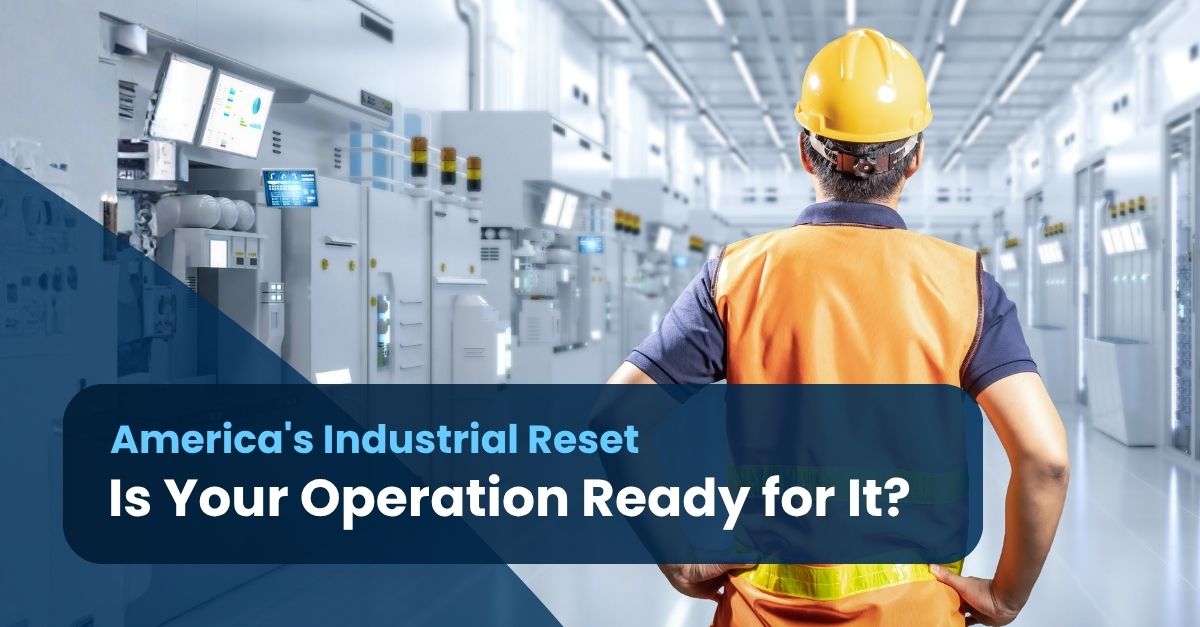
If you’ve felt the ground shifting under the global economy over the past few years, you’re not imagining it. We’re witnessing reindustrialization — the deliberate rebuilding of domestic manufacturing and strategic industries after decades of offshoring.
Supply Chain Fragility Exposed
The COVID-19 pandemic, Red Sea shipping disruptions, and repeated geopolitical shocks proved that just-in-time global supply chains are dangerously brittle. One distant factory shutdown or port closure can paralyze entire industries for months. We've all seen it happen.
Geopolitical Weaponization of Trade
Nations now treat trade, tariffs, export bans, and critical materials as strategic weapons. America's dependence on potential adversaries for semiconductors, pharmaceuticals, rare earths, and energy components creates real national security risk in a world that's no longer playing by the old rules.
Unsustainable Economic and Social Costs
Decades of offshoring produced chronic trade deficits, hollowed out the industrial Midwest, and stagnated wages for skilled workers while concentrating wealth in coastal finance and tech. That bill has come due.
This isn’t a temporary disruption. It’s a historic pivot — away from hyper-globalization toward an approach where nations prioritize their own production, energy security, and economic sovereignty. The United States is leading that shift, returning to the American System first championed by Alexander Hamilton and later advanced by Lincoln and McKinley: protective tariffs, investment in domestic manufacturing, and the infrastructure to support it.
Simple definition: reindustrialization is the onshoring, nearshoring, and expansion of high-value manufacturing and critical supply chains within the U.S. to restore industrial capacity lost to offshoring. It is the practical economic response to a post-globalization world that favors self-reliance over just-in-time efficiency from anywhere.
Serious macro thinkers — Peter Zeihan, Lyn Alden, Michael Every at Rabobank — identified this shift well before it became mainstream. They weren’t academics reading policy papers. They were practitioners watching commodity flows, physical constraints, and real-time market signals. They called it early because the data was already there.
What Reindustrialization Actually Delivers
Here’s what this shift means in practice for U.S. businesses:
Resilient supply chains. Decades of offshoring left the U.S. dependent on adversarial nations for critical inputs. Rebuilding domestic capacity reduces disruption risk and creates more predictable operations. Incentives like the CHIPS Act are accelerating that build-out.
Millions of new manufacturing jobs. Rebuilding factories requires skilled trades, engineers, and operational leadership — roles the U.S. labor market has undersupplied for thirty years.
Rising wages for skilled workers. Manufacturing jobs historically pay premiums over service roles. Reindustrialization reverses the wage stagnation that offshoring produced, with higher labor costs offset by productivity gains and domestic demand.
A narrowing trade deficit. Tariffs and domestic investment incentives shift the economics of production. More U.S.-based suppliers win contracts. Exporters benefit from a stronger industrial base.
Massive infrastructure and energy investment. Factories need power. Reindustrialization combined with AI and data center growth is driving significant investment in grid capacity, nuclear, natural gas, and renewables — creating opportunities across construction, equipment, and energy services.
Accelerated adoption of advanced technology. Bringing production home forces investment in robotics, AI-driven manufacturing, and advanced materials. The competitive edge goes to operations that build proprietary processes and iterate faster than competitors.
A multiplier effect for mid-market businesses. Large corporations reshore; they need local suppliers, logistics partners, and services. That creates real B2B opportunity for American mid-market companies throughout the supply chain.
Short-term cost pressure, long-term stability. Tariffs and onshoring raise input costs initially. But secure supply chains reduce volatility, and pricing power improves when quality and reliability command a premium.
Stronger GDP growth. Shifting from financialization to tangible production lifts capital investment and measured output. That creates broader economic expansion and more durable job security.
Restored strategic leverage. A reindustrialized America is less vulnerable to coercion — giving both policymakers and business leaders stronger negotiating positions.
The Bottom Line
Reindustrialization isn’t nostalgia. It’s the practical return to what actually built the world’s most powerful industrial economy. The forces that made hyper-globalization work for thirty years — cheap offshore labor, stable shipping, dollar hegemony — have reversed. They’re not coming back.
At POWERS, we work with manufacturers and operators navigating this shift — building the operational capability to meet the demand that reindustrialization is creating.
The American economy that built the 20th century is being rebuilt for the 21st. The time to get your operation ready is now.
For further reading: Lyn Alden — “The Hidden Costs of Reshoring” (August 2023): lynalden.com/reshoring Peter Zeihan — “Navigating Reindustrialization in a Deglobalized World” (November 2025): zeihan.com Michael Every, Rabobank — “Global Strategy: List-ing the Cans of Mercantilism” (May 2025): rabobank.com
About POWERS
Reindustrialization is creating real demand. The question is whether your operation is built to meet it.
POWERS works with manufacturers to close the gap between executive intent and frontline execution.
Through the development of Management Operating Systems and frontline leadership capability, POWERS helps organizations improve productivity, stabilize performance, and sustain results across shifts, sites, and operations.
DPS, our proprietary digital production platform, provides a single, trusted source of real-time performance visibility. By aligning data with daily execution and leadership expectations, DPS enables organizations to improve decision-making, reinforce accountability, and sustain performance gains over time.
- Speak to an Expert: Call +1 678-971-4711
- Email Us: info@thepowerscompany.com
- Request an Assessment: Visit our online contact form to schedule an assessment with our expert consultants.